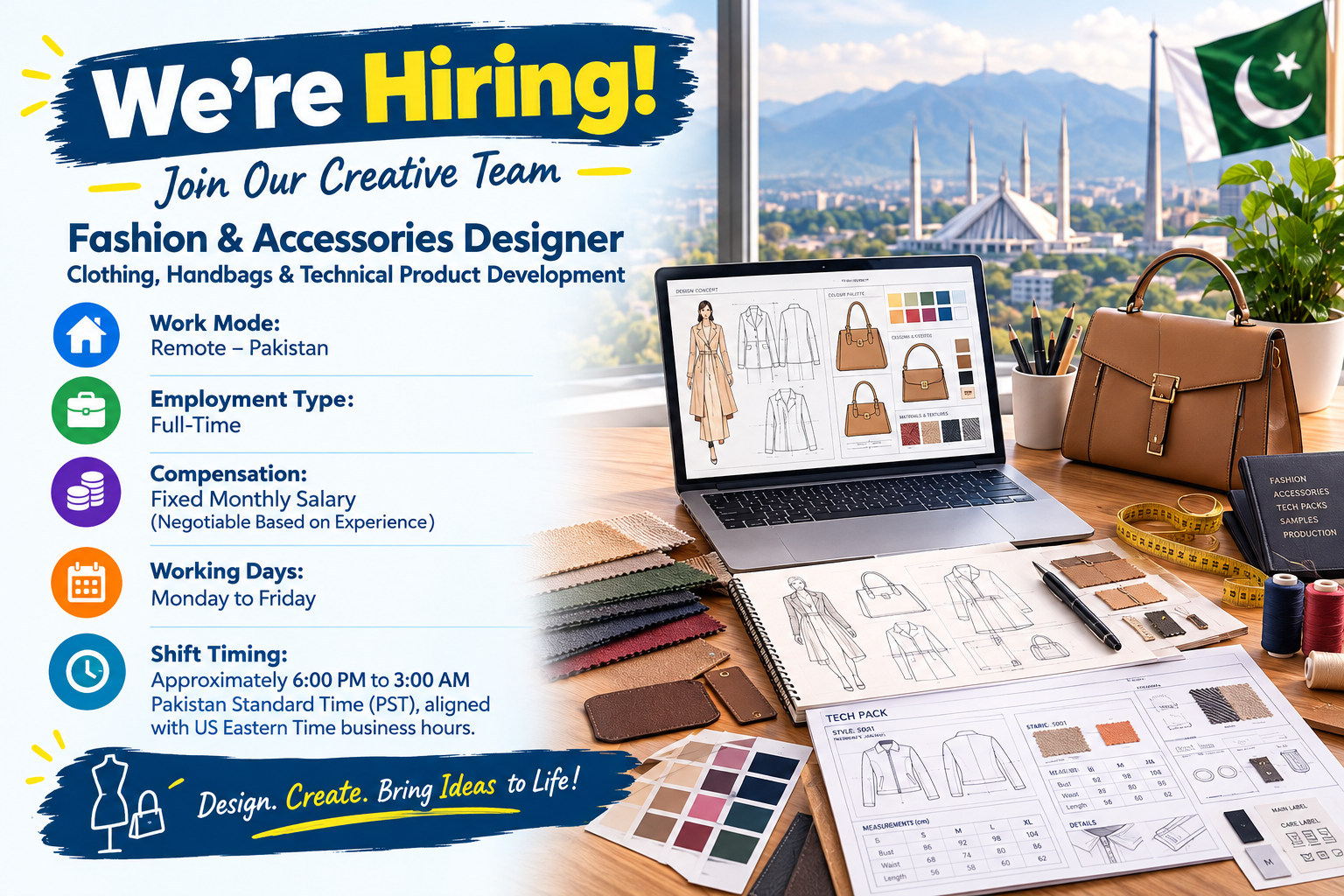
About the Role
We are looking for a highly skilled, detail-oriented, and creative Fashion & Accessories Designer with strong technical product development experience in clothing, handbags, and fashion accessories. The ideal candidate will be responsible for transforming creative ideas, reference images, sketches, and design concepts into professionally developed products supported by accurate, manufacturer-ready technical packs (tech packs).
This role requires a combination of creative design ability, technical knowledge, material expertise, and an understanding of how products are developed and manufactured. You should be able to take a product from the initial concept stage through technical documentation, sample development, revisions, and final approval for production.
We are particularly interested in candidates who understand that successful product development involves more than creating attractive designs. Every product must be clearly documented, with precise measurements, material specifications, construction details, hardware requirements, branding placements, and finishing instructions that allow manufacturers to produce the product as intended.
The successful candidate will work independently, maintain organized product documentation, and ensure that each design is practical, commercially viable, and ready for manufacturing.
Key Responsibilities
1. Fashion Design & Concept Development
- Develop original clothing, handbag, and fashion accessory designs based on creative briefs, market research, customer requirements, and visual references.
- Translate initial ideas, mood boards, reference photographs, and rough sketches into professional design concepts.
- Create hand-drawn or digital sketches that communicate the appearance, proportions, silhouette, and essential features of each product.
- Develop multiple design variations, including different colors, materials, finishes, patterns, and styling details where required.
- Research current fashion trends, seasonal collections, materials, color palettes, and competitor products to support the development of commercially relevant designs.
- Ensure that designs balance aesthetics, functionality, comfort, durability, manufacturability, and cost considerations.
- Create technical drawings showing front, back, side, top, bottom, and internal views as appropriate to the product.
- Include enlarged detail drawings for pockets, seams, closures, straps, handles, decorative elements, stitching, hardware, and other important construction features.
2. Complete Technical Pack (Tech Pack) Development
- Prepare comprehensive, professionally formatted tech packs for every clothing item, handbag, or accessory developed.
- Ensure each tech pack contains sufficient information for a manufacturer to understand the design and produce an accurate sample without unnecessary assumptions.
- Assign a unique style name, product code, or reference number to each design for easy identification and tracking.
- Include technical flats, design illustrations, construction drawings, product descriptions, and detailed specifications.
- Create product specification sheets covering dimensions, measurements, materials, components, colors, finishes, and construction requirements.
- Develop clear material and trim specification pages, including fabric or leather type, composition where known, thickness, weight, texture, finish, and color references.
- Document all essential construction details, including stitching methods, seam types, edge finishing, reinforcement points, lining attachment, and assembly instructions.
- Include reference images and visual callouts where they help manufacturers understand specific design requirements.
- Maintain consistent formatting, terminology, version control, and documentation standards across all product files.
3. Clothing Design & Garment Specifications
- Design clothing products such as shirts, T-shirts, trousers, jackets, dresses, outerwear, and other apparel categories according to project requirements.
- Develop technical garment drawings that accurately communicate silhouettes, panel construction, seam placement, collars, cuffs, hems, plackets, pockets, and closures.
- Prepare detailed measurement charts for each garment, identifying points of measurement (POM) and explaining how each measurement should be taken.
- Create size specifications and grading charts across required sizes, such as XS to XL or numerical sizing ranges.
- Document garment fit requirements, ease allowances, construction tolerances, and relevant fitting instructions.
- Specify fabrics, linings, interlinings, threads, buttons, zippers, snaps, labels, elastic, drawcords, and other components.
- Provide clear instructions for print placement, embroidery, appliqué, patches, decorative stitching, and other surface treatments.
- Support pattern development and sample fitting by identifying design adjustments and documenting approved revisions.
- Ensure that measurement specifications and garment construction details are consistent throughout the tech pack.
4. Handbag & Accessories Design
- Develop original handbag designs, including tote bags, shoulder bags, crossbody bags, handbags, backpacks, clutches, wallets, and other accessories as required.
- Prepare detailed technical drawings showing the front, back, sides, base, top opening, and internal structure of each product.
- Specify overall dimensions, body depth, gusset measurements, handle drop, strap length, strap width, and adjustable strap ranges.
- Design and document internal compartments, zippered pockets, slip pockets, card slots, dividers, closures, and organizational features.
- Specify the materials used for the outer body, lining, reinforcement, padding, backing, and structural support.
- Document leather, PU, synthetic leather, canvas, fabric, mesh, and other material requirements, including texture, thickness, color, and finish.
- Detail all hardware and functional components, including zippers, sliders, buckles, rings, clasps, magnetic snaps, feet, chains, rivets, and decorative fittings.
- Provide construction instructions for handles, straps, piping, edge paint, binding, topstitching, reinforcement, and attachment points.
- Ensure the design communicates the required balance between appearance, strength, usability, and manufacturing feasibility.
5. Bill of Materials (BOM) & Component Specifications
- Develop a complete Bill of Materials (BOM) for each product, listing every material and component required for manufacturing.
- Include main materials, lining, interlining, reinforcement, thread, zippers, buttons, buckles, labels, tags, hardware, trims, and packaging components where applicable.
- Specify material names, colors, finishes, sizes, quantities, supplier references, and product codes whenever this information is available.
- Clearly identify the location and application of each component within the product.
- Distinguish between mandatory specifications and approved alternatives where appropriate.
- Coordinate BOM information with technical drawings and measurement sheets to prevent inconsistencies.
- Update component specifications whenever a design change or sample revision affects material requirements.
6. Logo, Branding & Label Specifications
- Create dedicated logo, branding, and label specification pages for clothing and accessories.
- Document logo dimensions, colors, positioning, orientation, and spacing requirements.
- Specify branding application methods such as embroidery, screen printing, heat transfer, debossing, embossing, metal logos, woven labels, and leather patches.
- Develop specifications for main labels, size labels, care labels, composition labels, hangtags, and other required branding elements.
- Show the exact placement of labels and logos through technical drawings and measurements from clearly defined reference points.
- Include artwork files, color references, and production notes where necessary.
- Ensure branding details remain consistent across product variations and throughout the manufacturing documentation.
7. Manufacturer Communication & Sample Development
- Communicate with manufacturers, patternmakers, sample makers, and suppliers to clarify technical specifications and design requirements.
- Respond to questions about measurements, construction methods, materials, trims, and other product details.
- Review prototype and sample photographs or physical samples against the approved design and technical documentation.
- Identify discrepancies in dimensions, materials, stitching, proportions, construction, branding, and finishing.
- Provide clear, actionable feedback and revise technical drawings or specifications when necessary.
- Maintain a record of sample comments, revision dates, approvals, and outstanding production questions.
- Update tech packs after fitting sessions, manufacturer feedback, or design changes.
- Help ensure the final approved sample accurately reflects the intended design before bulk production begins.
8. File Management & Product Documentation
- Organize product development files using consistent folder structures, file names, product codes, and version numbers.
- Maintain editable source files and export manufacturer-ready documents in suitable formats, including PDF, AI, XLSX, and other required formats.
- Ensure technical drawings, measurement charts, BOMs, and material specifications remain synchronized.
- Check all deliverables for missing information, incorrect measurements, unclear callouts, formatting issues, and contradictory instructions before submission.
- Manage multiple products and development deadlines while maintaining a high standard of accuracy and professionalism.
Required Qualifications & Skills
- Proven professional experience in fashion design, handbag design, accessories design, or technical product development.
- A strong portfolio demonstrating original product designs and complete, production-ready tech packs.
- Excellent understanding of garment construction, patternmaking principles, sizing, fit, measurement methods, and manufacturing processes.
- Strong technical knowledge of handbag construction, materials, linings, reinforcement, hardware, and finishing techniques.
- Proficiency in Adobe Illustrator or equivalent software for technical flats, product illustrations, and specification documents.
- Working knowledge of Microsoft Excel or Google Sheets for measurement charts, BOMs, grading tables, and product specifications.
- Ability to create accurate technical drawings and communicate design details through clear visual documentation.
- Strong attention to detail, organization, problem-solving, and written communication.
- Ability to work independently, manage competing priorities, and deliver complete documentation within agreed deadlines.
- A practical understanding of manufacturing limitations, material availability, quality expectations, and production costs.
Preferred Qualifications
Experience with CLO 3D, Browzwear VStitcher, Lectra Modaris, Gerber, Optitex, or similar tools for 3D garment visualization, pattern development, grading, and fit assessment will be an advantage.
Experience working directly with clothing factories, handbag manufacturers, material suppliers, or private-label fashion brands is also desirable. Candidates who have managed products from initial concept through sampling and production approval will be especially valued.
Also check : How to make money online
Our Expectations
We value original thinking, technical precision, practical design decisions, and high-quality documentation. We are looking for someone who can take ownership of the product development process rather than simply create attractive sketches.
Every tech pack should be clear, complete, organized, and easy for a manufacturer to follow. Generic drawings, incomplete specifications, inconsistent measurements, and undocumented design assumptions will not meet our expectations.
The ideal candidate will combine creativity with a strong technical mindset, communicate effectively with manufacturing partners, and take pride in producing accurate, professional work.
What Success Looks Like
Success in this role means delivering original clothing and handbag designs supported by complete, accurate, and production-ready technical packs. You will help reduce manufacturing errors, improve sample accuracy, streamline communication with factories, and support a smooth transition from concept to approved product.
How to Apply
Apply here
Please submit the following:
- Your updated CV or professional résumé.
- A portfolio featuring clothing, handbag, and accessories designs relevant to your experience.
- Examples of complete tech packs, including technical drawings, material specifications, BOMs, measurement charts, construction instructions, and logo or label pages.
- Examples of sample revisions or manufacturer feedback you have handled, if available.
- A list of the design, technical drawing, patternmaking, and documentation software you use.
- Your availability, preferred working arrangement, and expected monthly salary or freelance rate.
Important: Please include examples of complete technical documentation rather than design illustrations alone. We want to understand your ability to translate creative concepts into accurate specifications that manufacturers can use to develop real products.
We look forward to working with a creative and technically capable professional who can help bring exceptional fashion and accessories products from concept to production.